What is tradition? – Roots, change, and the subtle lines in between.
Share
During Advent, many things become quieter – at least in our longing for it. While lights twinkle outside and the days seem to promise peace, many of us experience the exact opposite: appointments, preparations, expectations. And yet, beneath it all lies a quiet invitation: to pause, to feel, to remember.
Tradition is becoming particularly evident in our lives right now. Often quite subtly. In small gestures, familiar routines, in scents and tastes that instantly transport us back.
Where does tradition come from?
The word tradition comes from the Latin traditio – passing on, handing over, entrusting. Something is passed from one generation to the next, not as an obligation, but as a gift.
Tradition is thus a form of translation: the past is carried into the present. Not unchanged, but alive. It connects eras – and people.
Advent, remembrance and security
We feel this connection particularly strongly during the Christmas season. Perhaps it's an old cookie recipe that's brought out every year. Perhaps a particular dish that tastes just like Grandma used to make. Perhaps it's rituals that look different in every family – and yet always return.
This repetition provides security. It reminds us of our roots, of belonging, of a feeling of safety. Even when life changes, something familiar remains.
And yet, no two Christmases are alike. Even if we do similar things, we do them each time with different eyes, in a different phase of life, with new experiences in our hearts.
When tradition becomes difficult
Not every tradition feels easy. Some carry old patterns, expectations, or wounds that we may unconsciously carry with us. In such moments, the question may arise:
What nourishes me – and what needs to change?
Tradition becomes difficult when it becomes rigid. When it leaves no room for development, for new paths, for genuine feeling.
Tradition can change.
Tradition does not mean stagnation. It is not about clinging to the past at all costs. It can evolve, just as we evolve. We can decide what we want to preserve – and what we want to redesign.
Perhaps a new form of tradition will emerge precisely from this: a conscious one. One that feels good. One that supports us instead of holding us back.
My art during this time
These quiet questions also accompany my artistic work.
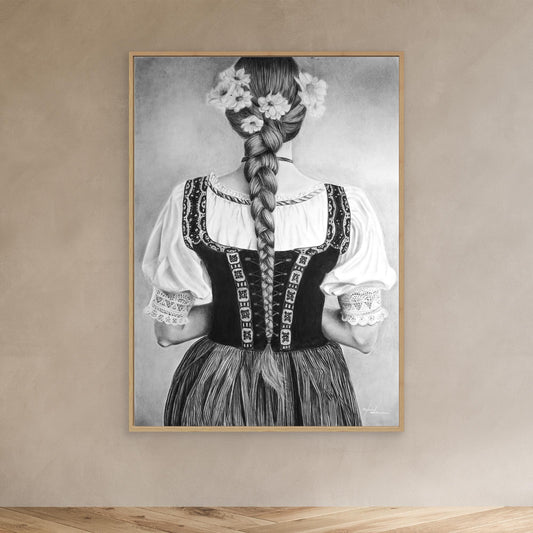
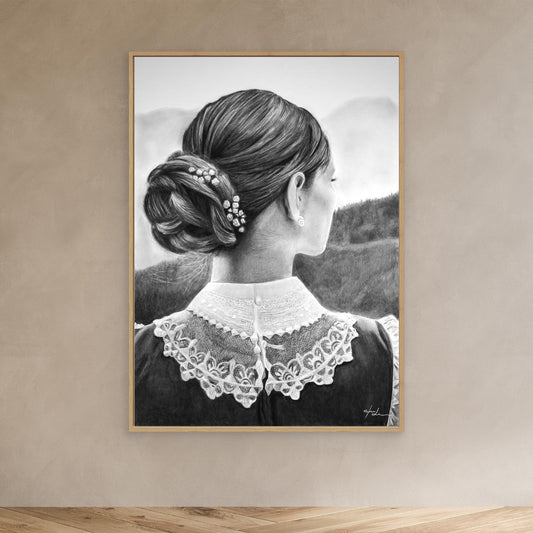
When I draw or paint women in traditional dress, I'm not interested in folklore or simply depicting tradition. It's about what lies beneath: origin, connection, lived history. About what has been passed down – both visible and invisible.
The women in my paintings stand still, yet are in motion. They carry their roots within them and simultaneously gaze into the distance. For me, they symbolize how tradition can be lived today: consciously, gently, and powerfully at the same time.
An invitation to Advent
Perhaps this time before Christmas is just the right moment to rediscover one's own traditions.
Not in doing, but in feeling. Not in perfecting, but in perceiving.
What does tradition mean to me today? What do I want to consciously experience this year?
If we allow ourselves to slow down, tradition can once again become what it is at its core: a quiet connection. To ourselves. To our roots. And to what we wish to pass on.
I wish you an Advent season in which space can be created for exactly that.